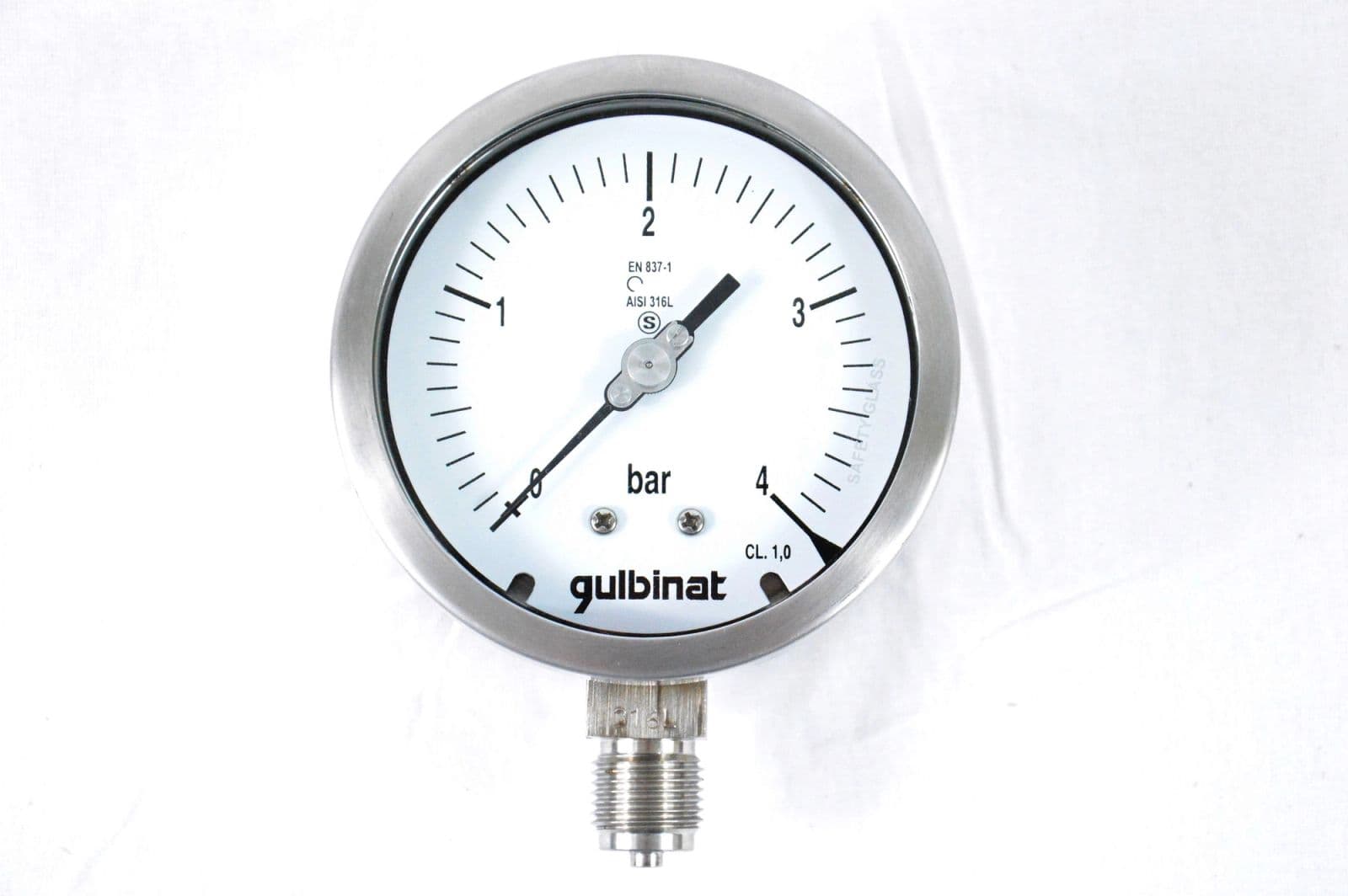
Sanitary Pressure Gauges: Why Standard Instruments Fail in Hygienic Processes
Standard pressure gauges harbour bacteria in dead spaces, use non-compliant materials, and cannot withstand CIP/SIP cycles. Learn what makes a gauge truly sanitary and how Gulbinat instruments meet the strictest hygienic requirements.
Pressure measurement is one of the most basic and ubiquitous measurements in any process plant. In non-critical applications, a standard bourdon tube gauge does the job. But in pharmaceutical production, biotech, dairy processing, and other hygienic industries, a standard gauge can become a contamination source — and a regulatory liability.
The Problem with Standard Gauges
A conventional pressure gauge typically connects to the process via a threaded socket or nipple. This creates a narrow dead space — a pocket of stagnant product that cannot be reached by cleaning fluids. Over time, bacteria colonise this space and potentially re-contaminate the process stream.
Additional issues with standard instruments in hygienic environments:
- Threaded connections create crevices that trap product residue
- Brass, carbon steel, and standard elastomers are not approved for food or pharma contact
- The bourdon tube mechanism cannot withstand CIP temperatures (up to 95 °C) or SIP conditions (121 °C, 2 bar)
- Gauge oil (glycerine filling) may leak into the process if the diaphragm fails
What Makes a Gauge Sanitary?
A truly sanitary pressure gauge addresses every one of these contamination pathways. The key design features are:
Flush-Mount Process Connection
Sanitary gauges use clamp (Tri-Clamp), DIN 11851, or Varivent connections that present a smooth, flush surface to the product. There is no dead leg, no thread, and no crevice. The measuring diaphragm sits flush with the pipe wall or vessel interior.
All-Stainless Wetted Parts
Wetted materials are typically 316L stainless steel with surface roughness ≤ 0.4 µm Ra (electropolished). Sealing elements use EPDM, FKM, or PTFE — all FDA and EC 1935/2004 compliant.
CIP and SIP Resistance
Sanitary gauges must withstand repeated thermal cycling: cold rinses, hot caustic washes (80–95 °C), acid rinses, and steam sterilisation at 121–134 °C. The diaphragm seal and housing are designed for these conditions without degradation or loss of accuracy.
Regulatory Requirements
- FDA 21 CFR: materials must be suitable for food and pharmaceutical contact
- EC 1935/2004: materials in contact with food must not transfer constituents in harmful quantities
- 3-A Sanitary Standards (14-02): requirements for pressure-sensing devices
- EHEDG guidelines: equipment design for hygienic processing
- ASME BPE: bioprocessing equipment standard, including surface finish and drainability
Gulbinat's Approach
Gulbinat, a German manufacturer within the Trinox group, has specialised in sanitary instrumentation for over 40 years. Their pressure gauge range is designed from the ground up for hygienic applications — not adapted from industrial models.
- Fully welded diaphragm seal with no O-ring in the product path
- Accuracy class 1.0 (EN 837-1) with optional class 0.6
- Process connections: Tri-Clamp, DIN 11851, Varivent, aseptic flange
- Temperature resistance up to 150 °C continuous
- Optional electrical output (4–20 mA) for process monitoring
As the exclusive Gulbinat partner in the Benelux, Tas & Company stocks a range of standard sizes and configurations for fast delivery. For non-standard requirements — unusual pressure ranges, special connections, or ATEX certification — we work directly with the Gulbinat engineering team in Germany.